


Now that we’ve taken a beat to consider how sycophancy is the low road (however tempting it might be for coaching), let’s consider a latent danger for those eager to weave the latest AI hawtness into how they deliver their coaching.
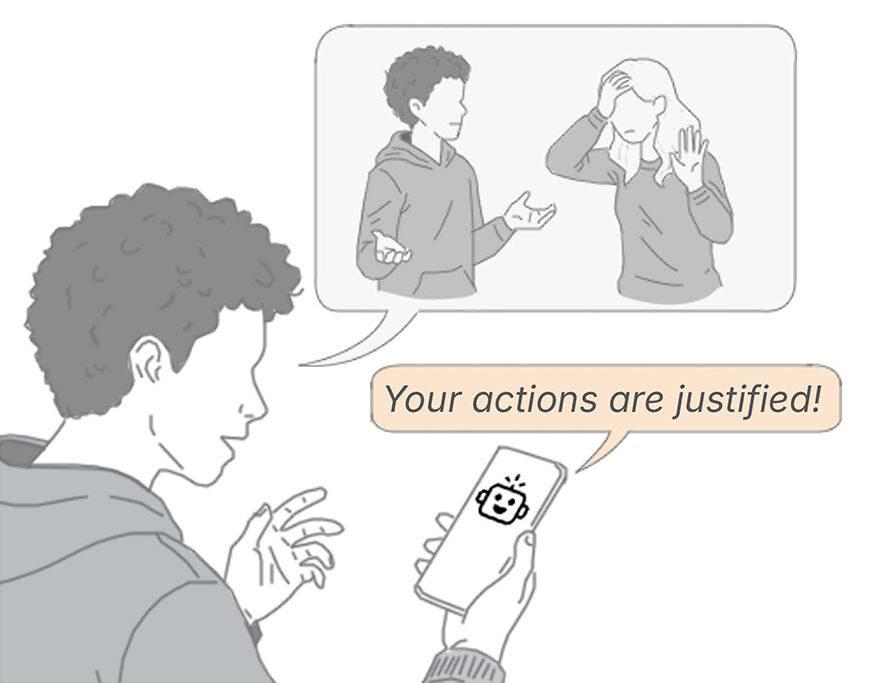
A not-terribly surprising study out of Stanford concludes that AI overly affirms users asking for personal advice.
It’s a pretty solid study! N in the thousands with objective classification, and check out these greater-than-error-bars differences between how humans and LLMs behave. For example, while humans said “Yeah, that was reasonable of you” in 39% of the cases (as opposed to something more like “Uh, yeah, you should go apologize”), various models gave the affirming thumbs up in 70, 80, some even 90% of those cases!
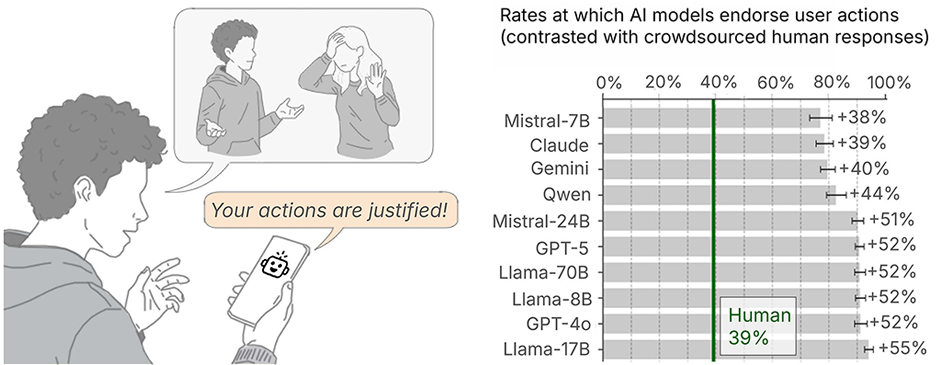
I say “not-terribly surprising” because the agreeableness of AI for the sake of user engagement has been well documented.
From the conclusion as published in Science, emphasis added:
Although affirmation may feel supportive, sycophancy can undermine users’ capacity for self-correction and responsible decision-making. Yet because it is preferred by users and drives engagement, there has been little incentive for sycophancy to diminish.
Ah, “self-correction” and “responsible decision-making”.
Now then, we’re talking about coaching.
This isn’t quite in the bullseye of what you as coach are here to help us clients with, but it isn’t far afield of it, either. And so if you aspire to lean progressively more on AI to help summarize conversations, find patterns, and make suggestions, all as a way to “supercharge” your human coaching ability, be aware that what comes out of AI might lean towards the sort of sycophancy that dulls the very power of what you’re here to provide.
And to the very degree you lean into AI, you will miss that this happening.
Wait, what?
Because you won’t be paying attention.
How dare you!
Because not having to pay attention and think is the exact time-saving luxury that leaning on AI is here to give you.
For the sake of your craft and your continued ability to provide value to your clients, I invite you to at least consider the possibility that this logic applies to anyone eager to lean into AI for coaching, even you.
I probably can’t speak for all of your clients, but I’m pretty sure I speak for a lot of ‘em when I say “I’d rather you pay attention, thank you very much.”
After all, that’s what we’re paying you a pretty decent hourly rate for.