



I put the word “mere” in front of “feelings” in the title of this not to diminish the importance of feelings, but to concede that, unlike things that can be objectively measured as unambiguously as reading a thermometer, feelings are subjective and don’t come with a handy printout of some easy-to-read number.
But so many coaching objectives lie in the realm of feelings, or qualities that are hard to judge without resorting to feelings. Objectives like:
- I want to feel more confident.
- I want to have a stronger relationship with so-and-so.
- I want to be a great communicator.
- I want to take more control of my life.
These sorts of outcomes resist meaningful measures, so the notion of progress (or lack thereof) is often murky. Spurred on by good feelings that arise when talking about ostensibly helpful steps taken, coaching can devolve into a process that feels productive yet is ultimately unfocused, not really getting anywhere.

So if we need to deal with coaching objectives that are based on squishy feelings (and we do), and we want to effectively guide clients toward satisfaction of those objectives (and we do), we’re going to need a way to meaningfully measure them.
How about a rating? You know, like “On a ten-point scale…” or “Out of five stars…”
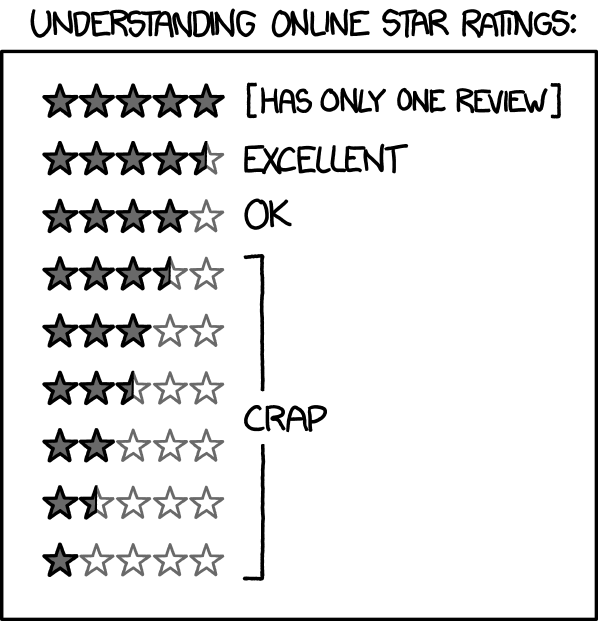
By themselves, we can recognize raw ratings as, shall we say, informationally lean:
But if we take a little time to adorn those rating values with specific descriptions of what they each signify? Such as “A rating of 1 means ____; 2 means ____; …”? When this is clearly defined up front, a simple numeric rating suddenly conveys much more. Additionally, the rating itself can be far more objectively gleaned, rather than based on a subjective feeling that can drift and slide with changes in mood and circumstance.
Let’s do this for some of our examples above.
“I want to feel more confident.” How about:
1 means “I’m pretty sure everything I touch will turn to sh*t.”
2 means “Things probably won’t go well, but I occasionally get lucky.”
3 means “I win some, I lose some; I’ll try but I’m not getting my hopes up.”
4 means “There are good odds I’ll accomplish whatever I set out to.”
5 means “If a thing is possible, I bet I’ll be able make it happen.”
You could present whomever with this scale, and they could readily tell you where they presently fall on it. If not in general, certainly within a specific area of life (e.g. career, relationships, business), or even further niched down (me personally, I’m a 5 when it comes to building CoachAccountable features, and a 3.2 when it comes to CoachAccountable marketing projects).
And yeah, with the anchor points clearly set, in-between values like 3.2 are easy enough to understand.
This ability to clearly rate oneself is because you’ve given them specifics that are relatable. Because the notion “I’m at 4 stars of confidence” is largely meaningless by itself, but suddenly it’s not when a 4 star rating is defined as “There are good odds I’ll accomplish whatever I set out to”, especially when nestled between those definitions of a 3 and a 5.
Such a scale transforms the game from “If I just collect a bunch of roughly 4’s and 5’s, I’ll be getting there!” to “If I consistently hit 5s, I’ve made it; and if I’m just hovering at whatever number, week in, week out, I know I’m not progressing.” The former amounts to telling yourself, “If I feel good about this for long enough, that means eventually I’ll win”, which both isn’t true and conveniently omits any sense for how long “long enough” will be. The latter gives a clear condition of winning, and a way to detect stagnation.
These scales aren’t even hard to create. I tossed off the confidence one in about three minutes, and you can, too.
Let’s do another one, “I want to have a stronger relationship with so-and-so.” How about:
1 means “I cringe at the thought of having to talk to them”
2 means “Our interactions are cordial and I don’t mind their presence”
3 means “We have non-trivial conversations and they are generally pleasant”
4 means “I actively seek them out as someone who’s company I genuinely enjoy”
5 means “We are mutually energized by one another’s company and practically never tire of it”
I took four minutes to cook up that one. I just made it up, but it’s relatable, isn’t it? Try rating your relationships with a few people, in your life, on that scale. Doesn’t your mind just snap to one number or another? Heck, I can think of a person with whom I’ve been at a 1, at a 5, and everything in between; and I could practically chart the progression for you over the years. It’s so clear, because the definitions of each rating are so relatable. That’s neat, but more to the point: this clarity gives you a foothold for delivering insightful and actionable coaching.
Let’s keep playing. How about “I want to be a great communicator”?
1 means “I can’t get the words out and would rather avoid needing to speak entirely”
2 means “I’ll get through it, but it takes a draining amount of effort”
3 means “I may stumble, and it’ll probably be okay”
4 means “I’ll gracefully convey what there is to convey, and they’ll reliably get it”
5 means “I generally nail it, and people love being on the receiving end of what I have to say”
Again, these can be niched down. The above rating descriptions could refer specifically to giving a speech, or conversations with a certain loved one, or communication with team members, etc.
When made as specific as it needs to be, any of these scales becomes a game that you as coach can work on with us clients. To have some real fun, invite us to work with you in designing these scales. We’ll be able to put in our own terms what things currently look like, and where we ultimately want to be as described in the aspirational highest rating.
Once created, these scales are the way by which we, together, can meaningfully measure what would otherwise be the stuff of mere feelings. We can then both have a clear sense of where things are, and where we would like them to be. By prompting us to report with a rating at a suitable and regular cadence, we’ll both know if we’re progressing or spinning our wheels. More importantly, it will be clear when we’ve won.
Okay, as a bonus, let’s do that last one: “I want to take more control of my life”. Try:
1 means “I am like a plastic bag being blown by the winds of life’s demands”
2 means “I cram what few priorities I can into the margins of everyone else’s”
3 means “I’m reasonably on track as I tread water of my obligations”
4 means “I’m largely in control while still meeting my obligations to others”
5 means “The only obligations I have are the ones I’ve fully chosen”
These are fun to do.
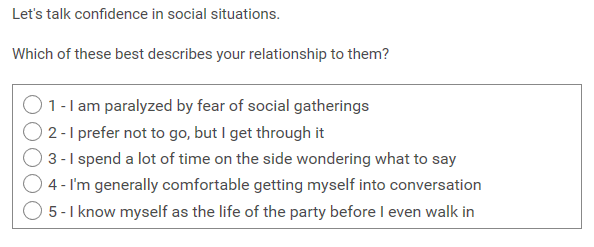
If you have your client fill out a routine tracking Worksheet, these can be reported on as a multiple-choice question, with the scales clearly defined for each: